 |
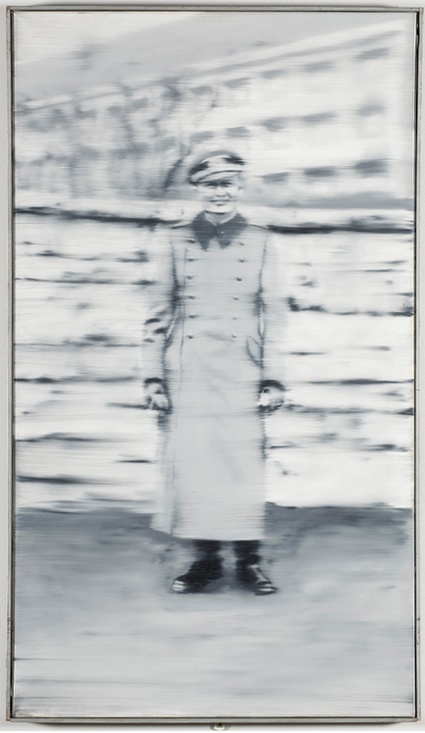
| Uncle Rudi, 1965 by Gerhard Richter |
In his introduction to Gerhard Richter: 40 Years of Painting, a book of text and plates based on the 2000 MoMA exhibition by the same name, Robert Storr, Senior Curator of the Department of Painting and Sculpture, points out how Richter was more articulate about his own work than any of his critics or admirers. Richter is an interesting painter because he was working after World War II in Germany and painting both in the Abstract Expressionist vein and in a Photorealist vein. His work is infamously difficult to categorize and often stems from a photographic process. Richter paints everything, from buildings to people, with the same attention to detail and then adds a layer of mechanical blurring to the image. In his introduction Storr notes Richter's own assertions about the themes that appear in his work:
"faith versus skepticism; hope versus pessimism; engagement versus neutrality; self-determination versus fatalism; imaginative freedom versus ideology" (17).
He also notes the observed empirical dichotomies that help illustrate these arguably socio-historic themes:
"impersonal iconography versus delicacy of facture; veiled intimacy versus formality of expression; chromatic austerity versus rich tactility; optical splendor versus physical remoteness; gestural exuberance versus strict self-censorship; resistance to easy pleasure versus exquisite hedonism; somberness versus playfulness; forthright assertion of image as object versus mistrust of the image as representation" (17).
If one artist's work can embody so many of the conflicts that draw people to art as a flexible medium, then does this imply that we should study Richter as a master of subject and technique and as contending with a set of difficult historical variables, which he could not represent other than through a simultaneous sensitivity to realism and an urgency for expressionism? If Richter's simple blurring techniques can straddle the boundary between Abstract Expressionism and Realism, as artists, do we consider this a merely formal gesture that participates differently in a discursive realm, or do we say that it is a discursive gesture from the start because it is impossible to separate the artist from his/her reception? When an artist decides to blur an edge, can the artist translate the intent of the gesture to the public?
In my opinion, the painting featured at the top of this article in a way examines Hannah Arendt's concept of the banality of evil. Richter portrays his uncle, who was a Nazi soldier during World War II, smiling. Germans living during his youth had many connections to the Nazi era, and they continue to haunt German consciousness to this day. The blurring of what initially was a hyperrealistic painting that was virtually indistinguishable from a photograph reminds us of this fine boundary between what is personal and what is a shared history and how our experience of it inevitably gets lost in representation through the retelling and distancing process. Many Germans of Richter's generation had their own uncle Rudy, the smiling soldier or bureaucrat who did Hitler's bidding because ... well personally I have a hard time imagining why, although I have read accounts justifying this kind of blind obedience through forcible coercion, social pressure or implicit coercion, the national priority or simply because most Nazis in the command chain did not directly experience the horrors of war and planned extermination. This painting stands a reminder of our common history and the implication of our own ancestors or relatives or friends or acquaintances in banal acts of violence and hate. Richter also painted in a similar style his Aunt Mariane, who had a mental illness and was forcibly sterilized and exterminated by the Nazi regime. His paintings are a reckoning with his own family's fraught history and the absurdity of the rise to power of man-made systematic killing machine that tore apart lives and families and blurred the boundary between reality and representation.
More on Gerhard Richter to come.
More on Gerhard Richter to come.
For now here is a link to an archive of his work: http://www.gerhard-richter.com/

No comments:
Post a Comment